
Artificial intelligence has reshaped the hiring landscape faster than most organizations expected. What used to be a human-centric process based on resumes, interviews, and intuition is now increasingly driven by algorithms, data models, and automated decision systems. AI speeds up recruitment, reduces costs, and helps employers process thousands of candidates at scale. Yet this efficiency comes with new risks. As AI becomes better at optimizing surface-level signals, the role of human validation has not disappeared—it has become more important. In this new environment, reference checks have shifted from a “nice-to-have” step to a critical safeguard against automation blind spots.
AI-Driven Recruitment and the New Hiring Reality
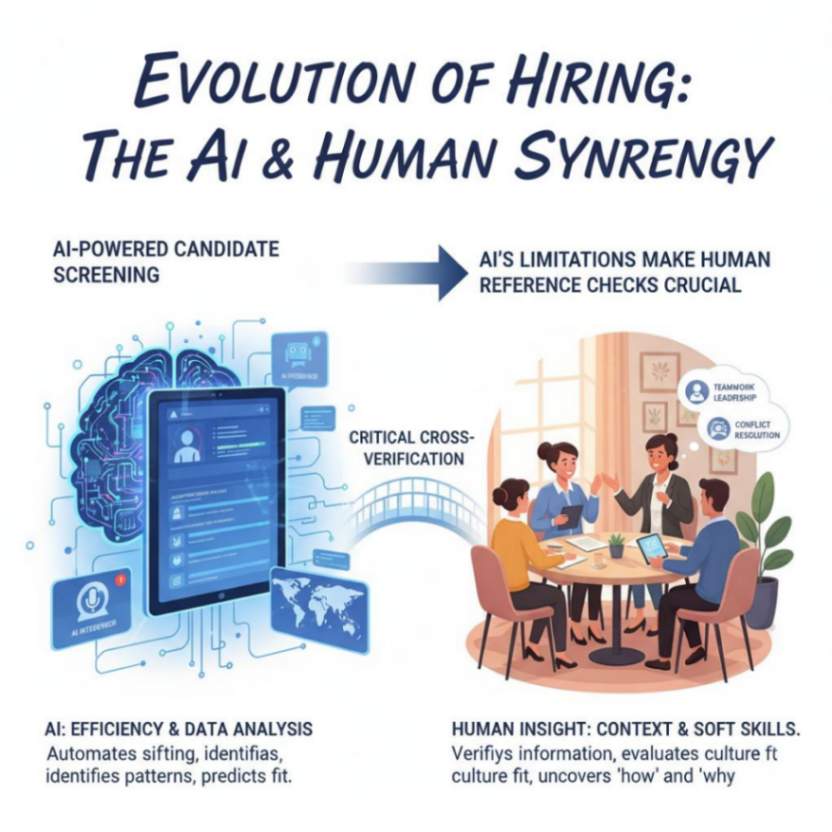
AI-powered recruitment tools now sit at the core of modern talent acquisition. Applicant tracking systems use machine learning to scan resumes, rank candidates, and predict job performance based on historical hiring data. Natural language processing evaluates cover letters and interview transcripts, while video interview platforms analyze tone, word choice, and facial cues. For employers facing intense competition for talent, these tools promise objectivity, speed, and consistency.
However, AI does not understand people in the same way humans do. It works with patterns, probabilities, and correlations derived from existing datasets. If a candidate’s resume matches successful profiles from the past, the system assumes higher potential. This can be effective for filtering large volumes of applicants, but it also means that AI primarily assesses how well a person fits predefined signals rather than how they actually perform in real-world teams.
This shift has changed what “screening” means. Instead of deeply evaluating behavior, ethics, adaptability, or interpersonal dynamics, AI often focuses on measurable proxies such as job titles, keyword density, employment duration, and education signals. As a result, candidates who are skilled at optimizing their digital footprint can outperform equally capable peers who are less familiar with algorithmic expectations.
The Limits of Algorithmic Evaluation
Despite impressive accuracy metrics, AI hiring systems remain limited by their inputs. They cannot independently verify truthfulness, context, or intent. A resume enhanced by AI writing tools may look flawless while masking performance issues, cultural misalignment, or interpersonal conflicts. Similarly, candidates can rehearse interview answers with generative AI, creating polished but generic responses that signal competence without demonstrating real experience.
Another challenge lies in bias amplification. AI models learn from historical data, and if past hiring decisions favored certain backgrounds or personality types, the system may replicate those patterns. This can exclude unconventional candidates or overlook red flags that do not appear in structured data. Moreover, AI struggles with soft signals such as accountability under pressure, ethical judgment, or how a person reacts to feedback—traits that often determine long-term success.
Because of these limitations, organizations increasingly recognize that AI alone cannot deliver reliable hiring decisions. Automation excels at narrowing the funnel, but it cannot fully replace human insight. This is where reference checks re-enter the spotlight as a crucial counterbalance to algorithmic screening.
Why Reference Checks Gained Strategic Importance
In an AI-driven hiring process, reference checks serve as one of the few mechanisms grounded in lived experience rather than inferred data. While algorithms predict potential, references validate reality. They provide context about how a candidate actually performed, interacted with others, and handled responsibility in real work environments.
As AI makes it easier for candidates to present an idealized version of themselves, employers need external perspectives to confirm alignment between claims and outcomes. References help answer questions AI cannot: Was this person reliable under stress? How did they contribute to team dynamics? Did they grow over time or repeat the same mistakes? These insights are not captured in resumes or assessment scores.
Reference checks also act as a fraud detection layer. In a market where resumes may be partially generated or optimized by AI, inconsistencies between candidate narratives and referee feedback become valuable signals. Rather than slowing down hiring, well-structured reference processes reduce costly mis-hires by identifying risks early.
How AI Changed the Nature of Reference Checks
AI has not only increased the importance of reference checks; it has also changed how they are conducted. Traditional reference calls were informal, subjective, and inconsistent. Today, many organizations apply structured frameworks, digital questionnaires, and data analysis to reference feedback, blending human insight with technological efficiency.
Modern reference checking platforms use standardized questions, anonymized responses, and comparative scoring models. This reduces bias and allows hiring teams to analyze patterns across multiple referees. AI can assist by flagging discrepancies, highlighting sentiment trends, and correlating reference feedback with role requirements. Importantly, AI supports the process without replacing human judgment.
At the core of this evolution lies a focus on behavioral validation. Instead of generic confirmations of employment dates, employers seek specific examples of performance, collaboration, and problem-solving. A well-designed reference process now complements AI screening by addressing its weakest areas.
In practice, effective reference checks focus on several key dimensions that algorithms struggle to measure accurately:
- Consistency between stated achievements and observed results.
- Quality of collaboration and communication within teams.
- Response to feedback, conflict, and change.
- Reliability, integrity, and accountability over time.
- Leadership potential or influence without formal authority.
By embedding these dimensions into structured reference frameworks, companies regain a more holistic view of candidates while maintaining hiring speed.
Balancing Automation and Human Validation
The future of recruitment is not a choice between AI and human judgment but a balance between the two. AI excels at processing scale and identifying statistical signals, while humans excel at interpreting nuance and context. Reference checks sit precisely at this intersection, translating lived experience into actionable hiring insight.
To achieve this balance, organizations increasingly integrate reference data into their broader hiring analytics. Reference feedback can be weighted alongside interview scores, skills assessments, and AI-generated predictions. When used correctly, references do not override data; they enrich it. A candidate with strong algorithmic scores but weak reference feedback may require deeper evaluation, while consistent signals across both increase confidence in the hire.
The following table illustrates how AI screening and reference checks complement each other across key hiring dimensions.
Before examining the table, it is important to understand that neither approach is sufficient on its own. Their combined value lies in covering each other’s blind spots rather than duplicating effort.
| Hiring Dimension | AI-Based Screening | Reference Checks |
|---|---|---|
| Speed and scalability | Extremely high, processes large volumes | Moderate, focused on shortlisted candidates |
| Resume and interview polish | Highly influential | Low relevance |
| Behavioral insight | Limited to inferred patterns | Based on direct observation |
| Contextual understanding | Minimal | High |
| Fraud and misrepresentation | Weak detection | Strong detection |
| Cultural and team fit | Indirect approximation | Direct feedback |
After reviewing this comparison, it becomes clear why reference checks have regained strategic importance. They do not compete with AI efficiency; they protect organizations from its limitations.
The Future of Reference Checks in AI-First Hiring
As hiring continues to evolve, reference checks will likely become more structured, data-informed, and strategically timed. Rather than being the final administrative step, they are increasingly positioned as a validation checkpoint before final offers. This shift reflects a broader understanding that trust cannot be automated.
AI will continue to improve at predicting performance, but it will also drive new forms of candidate optimization. As long as candidates adapt to algorithms, employers will need mechanisms rooted in human experience. Reference checks fulfill this role by grounding hiring decisions in reality rather than projection.
Organizations that treat reference checks as a critical component of AI-enabled hiring gain a competitive advantage. They reduce turnover, protect team culture, and make more resilient decisions in uncertain labor markets. In this sense, reference checks are no longer a legacy practice—they are a modern response to algorithmic hiring.
In conclusion, AI has transformed candidate screening by accelerating processes and expanding analytical capacity. At the same time, it has exposed the limits of automated evaluation. Reference checks have become critical because they provide what AI cannot: verified insight into real human behavior. In a hiring world shaped by algorithms, human validation is not obsolete—it is essential.